





Parkinson's disease
More than 50,000 patients
In the Netherlands, there are currently more than 50,000 people who have to deal with Parkinson's disease in a number of ways.'substantia nigra' The cells in that area die, for unknown reasons so far, slowly but surely. As the disease progresses, there is a growing decrease in dopamine production.'neurotransmitter' which is absolutely necessary in the brain. Neurotransmitters ensure that brain cells, called "neurons," In the event of a shortage of dopamine, communication between neurons is impaired, causing a lot of very annoying phenomena such as internal and external tremors, stiff muscles, slower movement and deterioration of fine motor skills.
Pills, pills and another pills
Extra dopamine cannot be administered directly."Levodopa" In most patients, this medicine is offered to the body via pills. Because it is absolutely necessary to avoid peaks and decreases in the amount of Levodopa in the body, this medicinal product should be taken every day. Some patients must take a large dose of Lev CYP tablets seven times a day.
Looking for an intake tool
The exact timing of taking so many pills requires a lot of discipline. When we were confronted with Parkinson's in our environment, we went looking for a reminder that warns when the weather is time for a new dose of pills. We found this, looking for long, in the form of a device specially developed by a Flemish Parkinson patient with technical knowledge and organizational insight. To keep a long story short, since about ten years this special medicine alarm has been on sale under two different names in a slightly different design.
Unknown to specialists
We were surprised when we discovered that neither specialised Parkinson neurologists nor various Parkinson nurses knew about the existence of these unique devices. Moreover, the devices are not very popular with mail order companies. Even a thorough search on Google delivers only one supplier in the Netherlands and one supplier for Belgium.
The GH700 Pillbox
Get to know the GH700
This electronic medicine alarm consists of a very small electronic timer with seven adjustable alarm times in which you can slide a seven-box pill box. The seven boxes are large enough to contain even the largest dose of Levodopa. The timer is equipped with an acoustic and a vibration alarm that you can switch on with a sliding switch separately or jointly. Of course, the set alarm times will remain in memory until you have to replace the AG13 or LR44 button cell, which serves as 1.5 V power supply.
The pill box cover can slide back and forth over the box, so that people with poor motor skills can also remove the pills from the box. It is enough to move the lid back to the desired medicine compartment. If one turns the box with one hand the pill automatically falls into the other hand or directly into a glass. Well thought out and ideal for people with Parkinson's!
 |
| The GH700 medicine alarm with up to seven alarm times. (© 2019 J. Verstraten) |
The electronics behind the GH700
As true electronics engineers, we could not resist the breakup of the device, curious as we are about the electronics that brings equipment to life. In the picture below we have shown the two sides of the tiny print. What is striking is that it is chosen for a single sided print, a rarity nowadays, which requires a few manually soldered parts and wires. As always both the pushbuttons and display are connected to the print by means of conductive rubber. The way the print is finished makes an unprofessional impression.
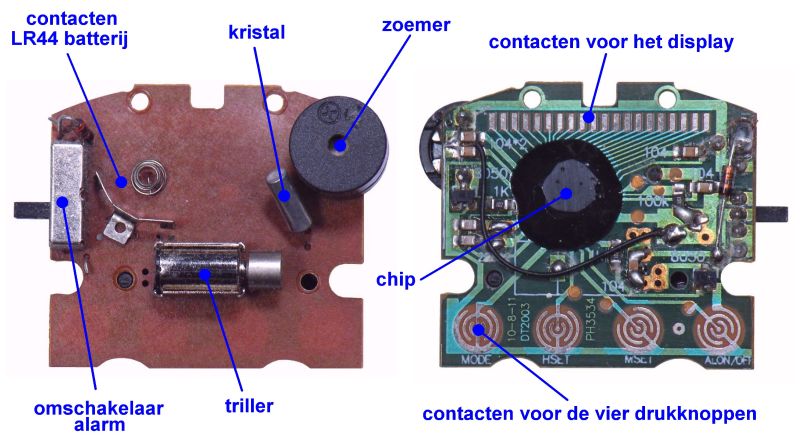 |
| This print contains all the electronics of the medicine alarm. (© 2019 Jos Verstraten) |
Setting the Time
The timer comes with set time. However, after replacing the battery you need to do this again. That's very easy. Press the MODE key for three seconds. The display starts blinking. You can then set the right time with the HR and MIN keys. Confirm by briefly pressing the MOde key.
Programming one or more alarm times
This is also easy to learn. Press the MODE key. Readout goes to '0:00:00' and above the seconds of numbers, the first alarm icon appears. Now press the MODE button for at least three seconds. The display starts to blink and you can set the time of the first alert with the HR and MIN keys. Press the MOde key to save the setting in the device's memory. To prove that this first alarm time is saved, the upper line of the display shows the icon of this first alert.
To set the second alarm time, briefly press the MODE button again. The second alarm icon appears above the second display and you can repeat the procedure described.
This simple way you can program all seven alarm times. If you only have to set three alarm times, of course, only programming the first three alarm hours.
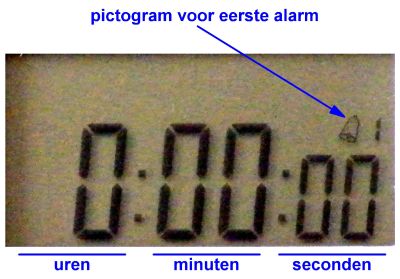 |
| Programming the first alarm. (© 2019 Jos Verstraten) |
Disable alarm times
Of course, the pill intake schedule may change and you will no longer need any of the set alarm times. Then press the MODE key until the icon of the alarm to be switched off appears above the seconds display. Then, press the AL button for a moment. The alarm is deactivated in the day programming but will remain in the device's memory. Similarly, you can activate a deleted alarm again.
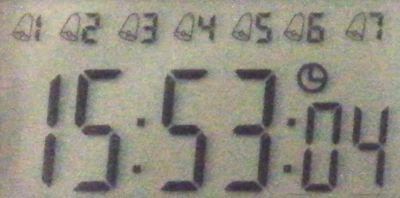 |
| The seven alarm times are all activated. (© 2019 Jos Verstraten) |
Enable the type of alarm
The slider on the right side of the device has three positions, which allows you to set the type of alarm:
A: only the buzzer.
Q: only the vibrator.
A/V: buzzer and vibrating together.
The JP7 Pillbox
Not one, but seven pill boxes.
The GH700 comes with one pill box, which you need to fill every morning. There is a fully identical working device available that comes with a holder with seven pill boxes. With this "JP7 Pillbox" So you can set up the full pill intake schedule for the patient in one go. Although the device works completely identical as the GH700 are both unfortunately not compatible. The pill boxes of the JP7 are slightly thinner and narrower than the pill box of the G H700 and these boxes do not fit the timer of the gH700.
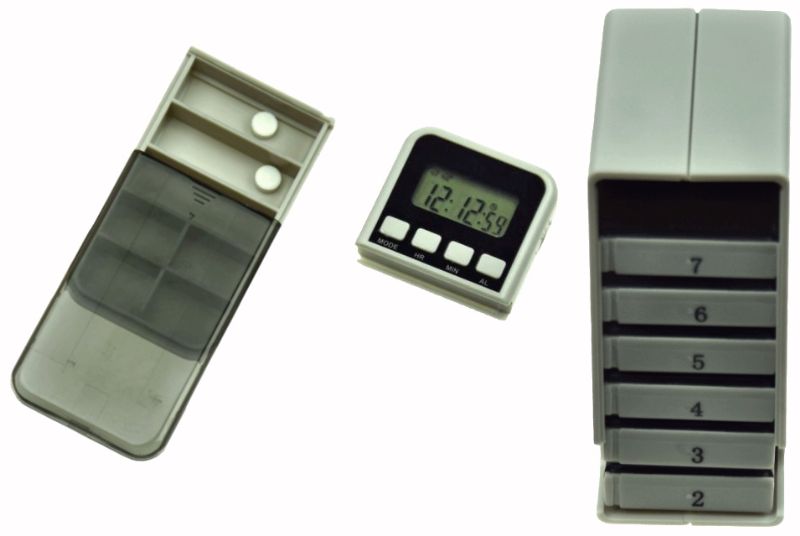 |
| The JP7 drug alarm with seven pill boxes. (© 2019 J. Verstraten) |

 and then Add to Home Screen.
