


5 different types
We divide all types of drinking cups into five large groups. Many properties are common in the different groups, each group has a Specific characteristic.
Type 1: Open cups
These cups look like normal cups but the difference is with the handles and the firm grip. The only disadvantage here is that the risk of choking remains, also there is often spilled. Some open cups have a lid with drinking tuit option to reduce this risk. However, a spout cup is often not the best solution, especially in case of swallowing problems, reduced oral motor skills or decreased intellectual functions.
Cups for persons with reduced arm/hand strength or motor skills. This cup is characterized by its ridges that strengthen the grip of the cup.Particularly practical cup with a very good grip in polycarbonate. The ventilation holes of the spout can be closed with a supplied rubber. This way the cup works like a "No-Spill cup." On this cup one can place a handle.
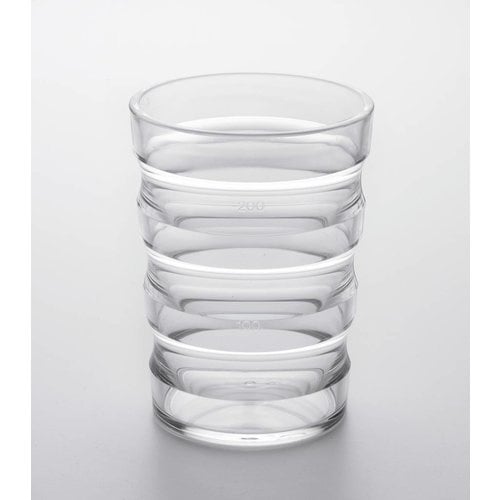
The insulating cup is useful for use with reduced strength and stability in the arms and hands. Special design inside, making drinking easier. It works on the principle of a nose cup and is an invisible adjustment at the same time. Nor does it matter on which side one drinks.

Transparent cup with 2 large handles and sloping spout, with an extra wide foot making it difficult to fall over. The large opening is ± 8 mm, the small one consists of 3 small holes.

Type 2: Cups with straw
The benefit from drinking out of a cup with a straw is that you don't have to bring the cup to your mouth, which reduces the risk of tampering But drinking with a straw can also be dangerous, for example if you suck by breathing (so using the airway open) so it is important to determine whether there is enough oral motor skills, whether there's understanding of the principle of sucking and no problem swallowing. Ask an expert, for instance an ergotherapist or a logopedist.
This cup is specially designed to Avoid spilling The large handle is suitable for Left-hand and right-handed persons The lid screwes tightly. Suitable for hot and cold drinks The straws drinking cup is useful because it has a large handle for better grip and is easy to use if you take a handle less easily due to problems with your movements and vibrations. The cup has a screw cover which does not leak this cup even if it falls over or if you keep it on its head. In the lid fits a straw where you can decide for yourself which straw you will use.
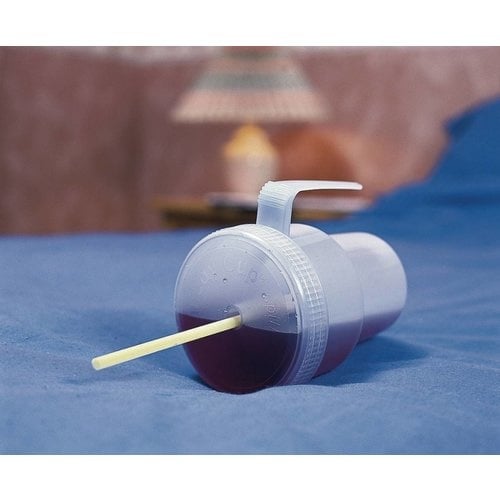
Special cup for bedridden, suitable for drinking lying down. This straw cup has a well-lockable lid, after the first sip the cup is leak free even if you knock over or drop the cup. The spout is constructed in such a way that it does not leak in lying. Suitable for hot and cold drinks.

Type 3: Cups against spills
Cups against spills use an in- or attachment to reduce the risk of spills, for example due to vibration or a movement restriction, to be reduced Using the in- or in-pack unit, the rate of outflow of the liquid from the cup is limited. So you have time to prepare for the sip, which means that there is less chance of swallowing. You still have to be able to dose the sipping yourself.
The SAS cup prevents the spills in case of motor limitation. Think of the disease of Parkinson's or MS The SAS cup works by the specially developed insert supplied to the cup. It can be "clicked" into the cup, and the surface of the insert prevents the fluid from moving smoothly. There are channels on the side of the entry point that flow through it when you want to take a sip. This flows at a speed of 15 to 18 ml/s.

The henibekers is a dosing cup used for spasms. Because of the shape of the lid you can take the liquid dosed until you avoid spilling. This cup holder is made of strong ABS and serves to prevent the To avoid spilling Suitable for most standard spout cups. Sturdy, widened base and 2 large handles.
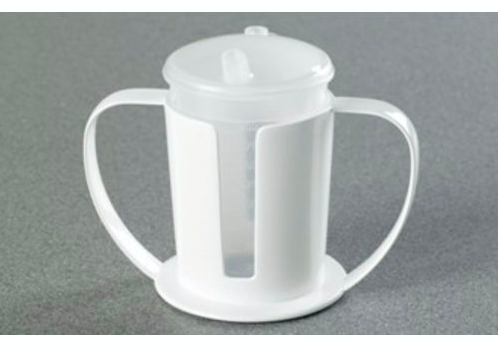
Ceramic white tremor cup with unique fan-shaped insert, which slows down the movement of the liquid as with a breaker. This makes the cup ideal for people with tremo r. The fan can be easily removed with the supplied Inox hook The fan is made of a fairly hard plastic and does not fit in cups with a different shape.

Type 4: Shaped drinking cups
A nose cut or a bevel shape makes it easy to drink from the cup without having to put your head back. These cups are often used when you are completely dependent on helping you drink. The guide sees better where the liquid is. A disadvantage of this kind of cups is that there is more chance of spilling, because the cups have been opened.
The Handycup is a very qualitative cupfor persons with loss of strength and coordination, developed by Danish ergotherapists.Handycup® is a convenient and original cup for children and adults to facilitate drinking. Glass clear, also available in various other transparent colors.
- The tilted design makes swallowing smoother, one should not hold the head back
- 2 large handles to hold the Handycup® well
- Wide foot making it difficult to fall over
- Transparent so that it is always clear how much liquid is included in the Handycup® 2 spout: opening of 4 mm for drinks and 8 mm for soup and yoghurt

A nose cup has a cut that causes the head and the neck less should be moved This makes swallowing easier and less likely to spill. This cup is very easy to hold because of its shape and rough surface. Moreover, a handy cup is to teach young children how to drink. You start with little liquid in the cup, so your child gets used to drinking from a cup with a edge rather than sucking through a straw or bottle with teat or spout.


The increased dysphagia cup is a bevel cup with a large handle. By his oval shape the nose falls when drinking in the beak r and can be used without tilting your head backwards from the cup. Convenient if you have neck problems, pain or a movement restriction in your neck. Can also be useful for coordination problems. And it just swallows easier if you don't have to bend your head back.
Type 5: Cup with sip dose
With a cup with sip dosage you decide in advance how many milliliters of liquid you drink per sip. After each sip, you tilt the cup to refill the dosing system. Dosing is important in case of swallowing problems, if you cannot dose the liquid yourself, if your tendency is to drink too fast (but do want to drink independently) or spill it.
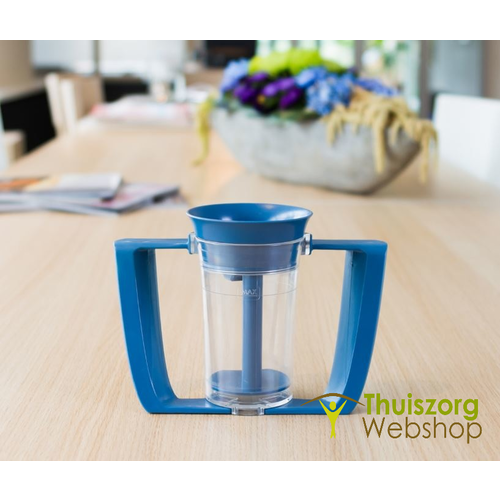
The Total Cup is a new drinking cup. A solution for less choke and more independence. Developed from practice and science. Slicking is a very complex movement and takes about 2 seconds. People swallow 800 to 2400 times a day. Suffice is a problem! Dysphagia (disorders of swallowing) occurs in all age groups. Of the Dutch population, 0.11 to 22.6% have dysphagia. Use of a good drinking cup reduces the risk of swallowing.
For more information about more efficient drinking/Swallowing: click here

 and then Add to Home Screen.
